PacBio DADA2-ccs plugin is losing lots of data

Howdy,
I ran DADA2-ccs plugin for PacBio sequences for Bac16S but I am losing a lot of reads in filtering step. Search:

sample-id
#q2:types
input
numeric
primer-removed
numeric
percentage of input primer-removed
numeric
filtered
numeric
percentage of input passed filter
numeric
denoised
numeric
non-chimeric
numeric
percentage of input non-chimeric
numeric
T1S1 29088 25021 86.02 17060 58.65 512 508 1.75
T1S1_2 63054 54970 87.18 38383 60.87 2060 2057 3.26
T1S2 50234 43689 86.97 30540 60.8 1596 1596 3.18
T1S2_2 70523 61689 87.47 41379 58.67 1861 1858 2.63
T1S3 69233 61022 88.14 41808 60.39 2184 2180 3.15

This is the code I ran:
#!/bin/bash

##NECESSARY JOB SPECIFICATIONS
#SBATCH --job-name=DADA2_ccs #Set the job name to "JobExample4"
#SBATCH --time=30:00:00 #Set the wall clock limit
#SBATCH --ntasks=8 #Request 1 task
#SBATCH --mem=95G #Request 2560MB (2.5GB) per node
#SBATCH --output=DADA2_ccs.%j #Send stdout/err to "Example4Out.[jobID]"

#First Executable Line

ml load Anaconda3
ml load QIIME2/2026.1-Amplicon

qiime dada2 denoise-ccs
--i-demultiplexed-seqs demux.qza
--p-min-len 1300
--p-max-len 1600
--p-max-ee 5
--p-front AGRGTTYGATYMTGGCTCAG
--p-adapter RGYTACCTTGTTACGACTT
--o-representative-sequences rep-seqs.qza
--o-denoising-stats denoising-stats.qza
--o-table table.qza
--p-n-threads 12

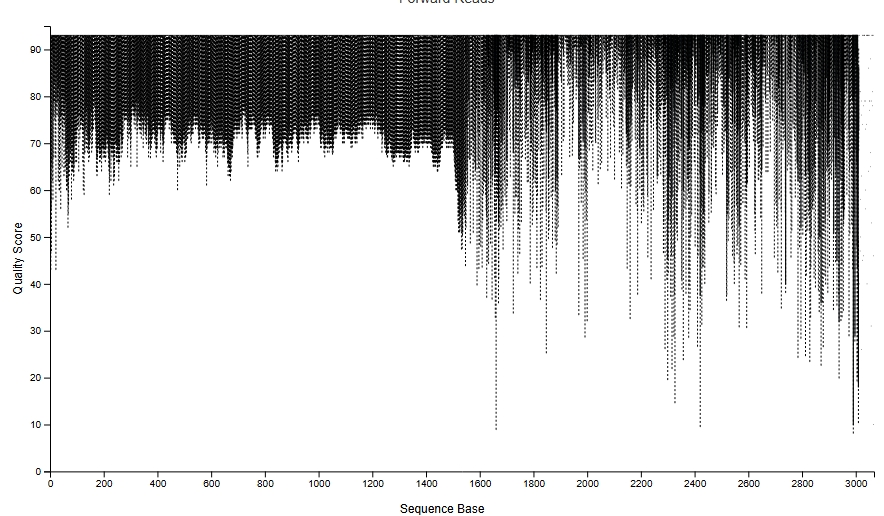
I have also tried different max-ee levels with little to no difference at all. This is my demux.qzv for bac 16S:


However, for ITS PacBio data, the denoising stat looks a lot better: Search:

sample-id
#q2:types
input
numeric
primer-removed
numeric
percentage of input primer-removed
numeric
filtered
numeric
percentage of input passed filter
numeric
denoised
numeric
non-chimeric
numeric
percentage of input non-chimeric
numeric
T1S1 36669 32754 89.32 26279 71.67 20914 17727 48.34
T1S1_2 62619 55118 88.02 43673 69.74 32901 27308 43.61
T1S2 40653 36193 89.03 29730 73.13 22792 20879 51.36
T1S2_2 42683 37769 88.49 29678 69.53 21376 20240 47.42
T1S3 39285 34841 88.69 27769 70.69 21030 19973 50.84
T1S3_2 51719 45597 88.16 36461 70.5 26836 24498 47.37

I am basically having this problem with bacterial data. Help me please!

Hello @Prajina-N!

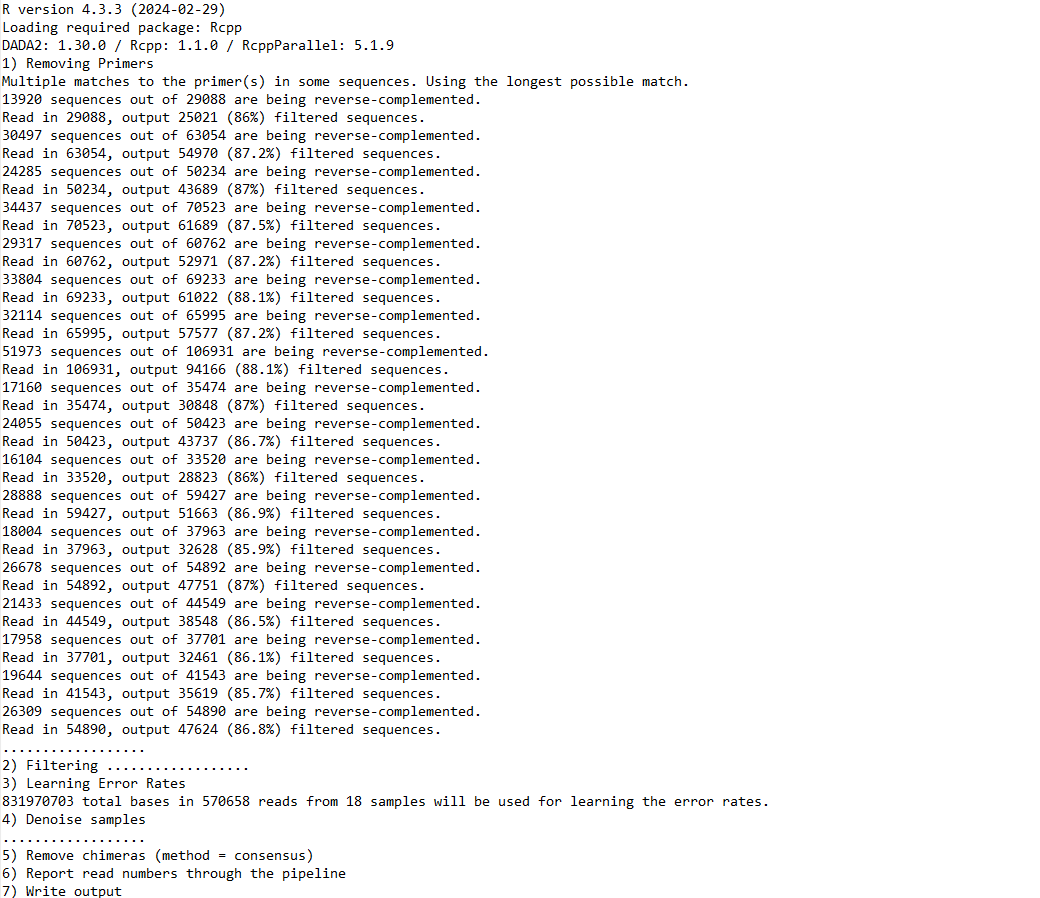
Would you be able to track down a log file for one of these runs? I think we should see the number of unique sequences printed to stdout which may be helpful in finding the issue.

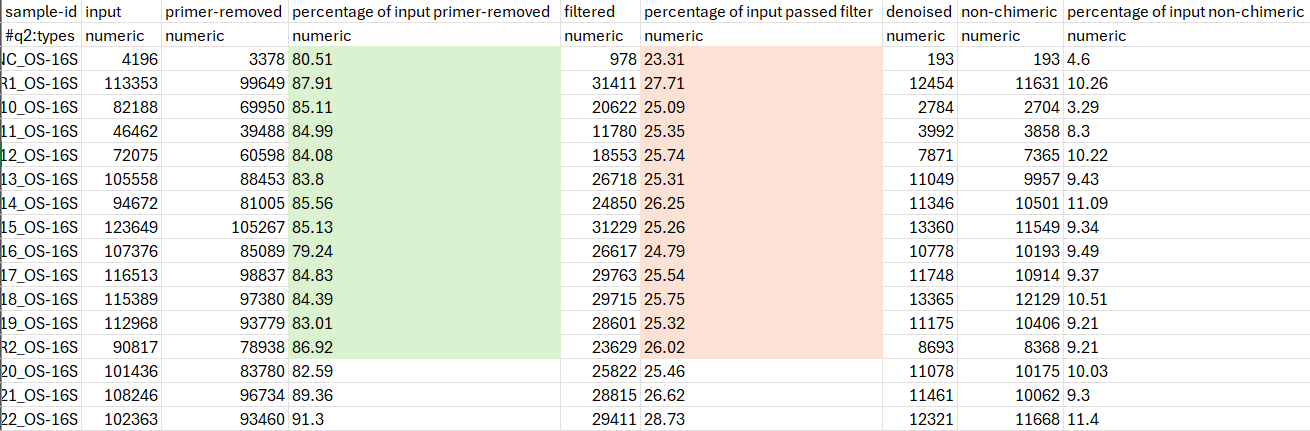
Hi there, I also encountered a similar issue with by PacBio ccs reads. See below.

The command I used:

============

qiime dada2 denoise-ccs \

--i-demultiplexed-seqs os_imported-seqs.qza \

--p-min-len 1000 \

--p-max-len 1600 \

--p-max-ee 2 \

--p-front "AGRGTTYGATYMTGGCTCAG" \

--p-adapter "RGYTACCTTGTTACGACTT" \

--p-n-threads 8 \

--p-pooling-method pseudo \

--o-table os_feature-table.qza \

--o-representative-sequences os_rep-seqs.qza \

--o-denoising-stats os_denoising-stats.qza \

=========

I see that you even used a higher max-ee value, will try to use a higher one on mine to see if that helps. Additionally, I even used 'indepedent' pooling method but still came up short.

Perhaps a question for everyone, can one still proceed with downstream analyses despite this significant loss of reads after filtering?

Hi ebolyen,
Thank you for replying. Please find the attached verbose log:


Hi Mukhari_R,
I tried multiple max error, like 2, 5 but it did not make much difference in the reads that passed the final filter.
I am wondering if that might be the sequence quality itself. I am not entirely sure how that could happen.