# PacBio DADA2-ccs plugin is losing lots of data
**URL:** https://forum.qiime2.org/t/pacbio-dada2-ccs-plugin-is-losing-lots-of-data/34299
**Category:** User Support
**Tags:** queued
**Created:** [August 27, 2026, 3:21pm UTC](https://forum.qiime2.org/t/pacbio-dada2-ccs-plugin-is-losing-lots-of-data/34299 "2026-08-27T15:21:24Z")
**Posts on this page:** 7
**Page:** 1
### Author:  [@Prajina-N](https://forum.qiime2.org/u/Prajina-N)
#### Post date: [August 27, 2026, 3:21pm UTC](https://forum.qiime2.org/t/pacbio-dada2-ccs-plugin-is-losing-lots-of-data/34299/1 "2026-08-27T15:21:24Z")
Howdy,
I ran DADA2-ccs plugin for PacBio sequences for Bac16S but I am losing a lot of reads in filtering step. Search:
| sample-id
**#q2:types** | input
**numeric** | primer-removed
**numeric** | percentage of input primer-removed
**numeric** | filtered
**numeric** | percentage of input passed filter
**numeric** | denoised
**numeric** | non-chimeric
**numeric** | percentage of input non-chimeric
**numeric** |
| --- | --- | --- | --- | --- | --- | --- | --- | --- |
| T1S1 | 29088 | 25021 | 86.02 | 17060 | 58.65 | 512 | 508 | 1.75 |
| T1S1\_2 | 63054 | 54970 | 87.18 | 38383 | 60.87 | 2060 | 2057 | 3.26 |
| T1S2 | 50234 | 43689 | 86.97 | 30540 | 60.8 | 1596 | 1596 | 3.18 |
| T1S2\_2 | 70523 | 61689 | 87.47 | 41379 | 58.67 | 1861 | 1858 | 2.63 |
| T1S3 | 69233 | 61022 | 88.14 | 41808 | 60.39 | 2184 | 2180 | 3.15 |
This is the code I ran:
#!/bin/bash
##NECESSARY JOB SPECIFICATIONS
#SBATCH --job-name=DADA2\_ccs #Set the job name to "JobExample4"
#SBATCH --time=30:00:00 #Set the wall clock limit
#SBATCH --ntasks=8 #Request 1 task
#SBATCH --mem=95G #Request 2560MB (2.5GB) per node
#SBATCH --output=DADA2\_ccs.%j #Send stdout/err to "Example4Out.[jobID]"
#First Executable Line
ml load Anaconda3
ml load QIIME2/2026.1-Amplicon
qiime dada2 denoise-ccs
--i-demultiplexed-seqs demux.qza
--p-min-len 1300
--p-max-len 1600
--p-max-ee 5
--p-front AGRGTTYGATYMTGGCTCAG
--p-adapter RGYTACCTTGTTACGACTT
--o-representative-sequences rep-seqs.qza
--o-denoising-stats denoising-stats.qza
--o-table table.qza
--p-n-threads 12
I have also tried different max-ee levels with little to no difference at all. This is my demux.qzv for bac 16S:
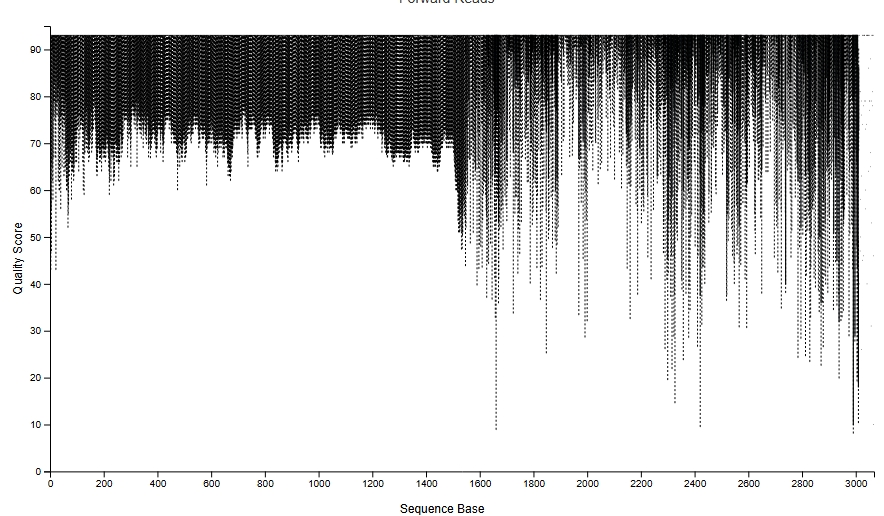
However, for ITS PacBio data, the denoising stat looks a lot better: Search:
| sample-id
**#q2:types** | input
**numeric** | primer-removed
**numeric** | percentage of input primer-removed
**numeric** | filtered
**numeric** | percentage of input passed filter
**numeric** | denoised
**numeric** | non-chimeric
**numeric** | percentage of input non-chimeric
**numeric** |
| --- | --- | --- | --- | --- | --- | --- | --- | --- |
| T1S1 | 36669 | 32754 | 89.32 | 26279 | 71.67 | 20914 | 17727 | 48.34 |
| T1S1\_2 | 62619 | 55118 | 88.02 | 43673 | 69.74 | 32901 | 27308 | 43.61 |
| T1S2 | 40653 | 36193 | 89.03 | 29730 | 73.13 | 22792 | 20879 | 51.36 |
| T1S2\_2 | 42683 | 37769 | 88.49 | 29678 | 69.53 | 21376 | 20240 | 47.42 |
| T1S3 | 39285 | 34841 | 88.69 | 27769 | 70.69 | 21030 | 19973 | 50.84 |
| T1S3\_2 | 51719 | 45597 | 88.16 | 36461 | 70.5 | 26836 | 24498 | 47.37 |
I am basically having this problem with bacterial data. Help me please!
---
### Author:  [@ebolyen](https://forum.qiime2.org/u/ebolyen)
#### Post date: [August 31, 2026, 10:56am UTC](https://forum.qiime2.org/t/pacbio-dada2-ccs-plugin-is-losing-lots-of-data/34299/2 "2026-08-31T10:56:00Z")
Hello @Prajina-N!
Would you be able to track down a log file for one of these runs? I think we should see the number of unique sequences printed to stdout which may be helpful in finding the issue.
---
### Author:  [@Mukhari\_R](https://forum.qiime2.org/u/Mukhari_R)
#### Post date: [September 1, 2026, 1:10pm UTC](https://forum.qiime2.org/t/pacbio-dada2-ccs-plugin-is-losing-lots-of-data/34299/3 "2026-09-01T13:10:47Z")
Hi there, I also encountered a similar issue with by PacBio ccs reads. See below.
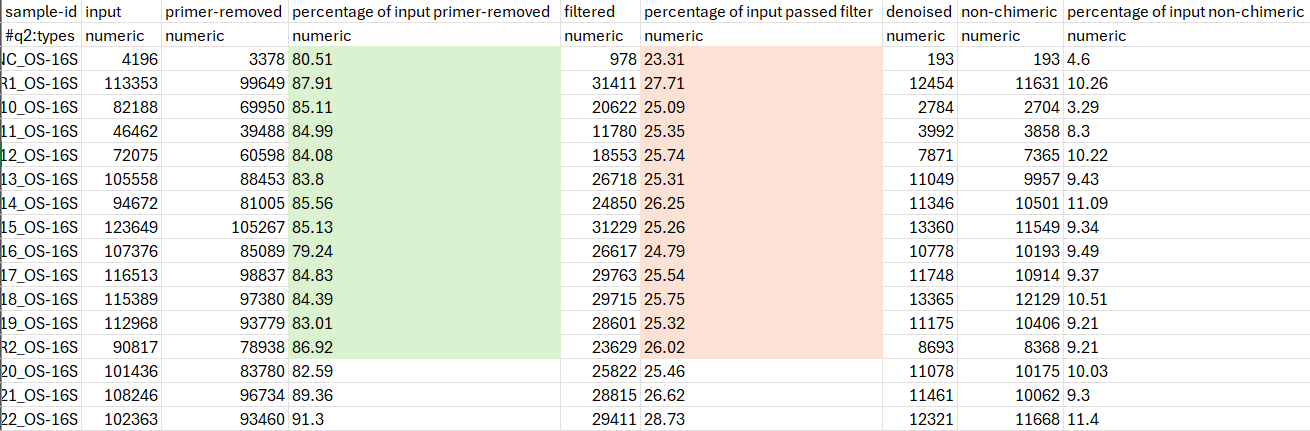
The command I used:
============
qiime dada2 denoise-ccs \
--i-demultiplexed-seqs os\_imported-seqs.qza \
--p-min-len 1000 \
--p-max-len 1600 \
--p-max-ee 2 \
--p-front "AGRGTTYGATYMTGGCTCAG" \
--p-adapter "RGYTACCTTGTTACGACTT" \
--p-n-threads 8 \
--p-pooling-method pseudo \
--o-table os\_feature-table.qza \
--o-representative-sequences os\_rep-seqs.qza \
--o-denoising-stats os\_denoising-stats.qza \
=========
I see that you even used a higher max-ee value, will try to use a higher one on mine to see if that helps. Additionally, I even used 'indepedent' pooling method but still came up short.
Perhaps a question for everyone, can one still proceed with downstream analyses despite this significant loss of reads after filtering?
---
### Author:  [@Prajina-N](https://forum.qiime2.org/u/Prajina-N)
#### Post date: [September 2, 2026, 8:06am UTC](https://forum.qiime2.org/t/pacbio-dada2-ccs-plugin-is-losing-lots-of-data/34299/4 "2026-09-02T08:06:19Z")
Hi ebolyen,
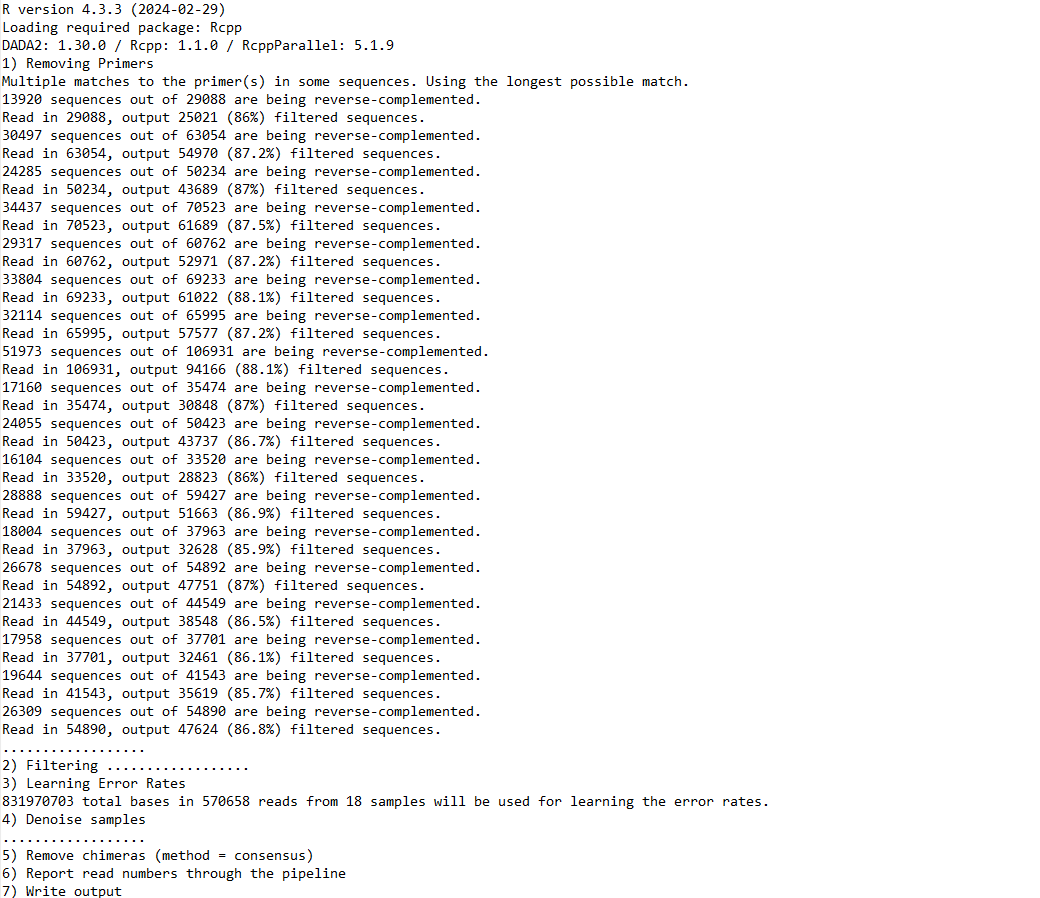
Thank you for replying. Please find the attached verbose log:

---
### Author:  [@Prajina-N](https://forum.qiime2.org/u/Prajina-N)
#### Post date: [September 2, 2026, 8:06am UTC](https://forum.qiime2.org/t/pacbio-dada2-ccs-plugin-is-losing-lots-of-data/34299/5 "2026-09-02T08:06:28Z")
Hi Mukhari\_R,
I tried multiple max error, like 2, 5 but it did not make much difference in the reads that passed the final filter.
I am wondering if that might be the sequence quality itself. I am not entirely sure how that could happen.
---
### Author:  [@benjjneb](https://forum.qiime2.org/u/benjjneb)
#### Post date: [September 9, 2026, 6:38pm UTC](https://forum.qiime2.org/t/pacbio-dada2-ccs-plugin-is-losing-lots-of-data/34299/7 "2026-09-09T18:38:00Z")
Low rates of successful denoising, which is where you are losing most of your 16S reads, can happen when there is little duplication in the data, either due to relatively high error rates (more of an issue with long reads) or very high levels of sample diversity (so even real biological sequences are only being observed a handful of times or less). But what is surprising is that you aren't seeing the same issue in your ITS sequences.
Were there any differences in the library preparation/sequencing of your 16S data versus your ITS data? For example, was Kinnex used for one and not the other? How long is the ITS region you are amplifying?
---
### Author:  [@Prajina-N](https://forum.qiime2.org/u/Prajina-N)
#### Post date: [September 22, 2026, 3:03am UTC](https://forum.qiime2.org/t/pacbio-dada2-ccs-plugin-is-losing-lots-of-data/34299/8 "2026-09-22T03:03:27Z")
Hi Ben,
The lab said that they use same method for both ITS and 16S PacBio only the primers are different. Full 16S
F: AGRGTTYGATYMTGGCTCAG
R: RGYTACCTTGTTACGACTT
Full ITS
F: ACCWGCGGARGGATCATTA
R: TCCTGAGGGAAACTTCG